
LinkedIn has become one of the most important channels for B2B growth. It is where buyers form early opinions, where credibility is evaluated, and where thought leadership compounds long before a sales conversation begins.
For founders, this creates a clear expectation. Showing up consistently is no longer optional. It is part of how modern B2B brands are built.
The challenge is not a lack of insight. Most founders already have strong opinions shaped by real experience. The difficulty is turning that thinking into consistent, high-quality content without it becoming another operational burden.
This is exactly where structure becomes critical.
At Shake Content, we help B2B founders, teams, and leaders build LinkedIn thought leadership through strategic content systems and personalised frameworks. The goal is not to post more. It is to create a repeatable content engine that turns everyday thinking into consistent output.
One of the most effective ways to do that is through a simple framework we call the CRIT Method.
Many founders approach LinkedIn content as a series of isolated tasks. Each post starts from zero. A new idea needs to be found, structured, written, and refined every time.
This creates unnecessary friction.
Over time, three patterns tend to emerge. Decision fatigue builds as content competes with more important business priorities. Consistency becomes dependent on energy rather than structure. Eventually, posting slows down or stops entirely.
The issue is rarely creativity or discipline. It is the absence of a system that removes the need to constantly start from scratch.
This is why high-performing B2B thought leadership is rarely driven by motivation alone. It is driven by repeatable workflows.
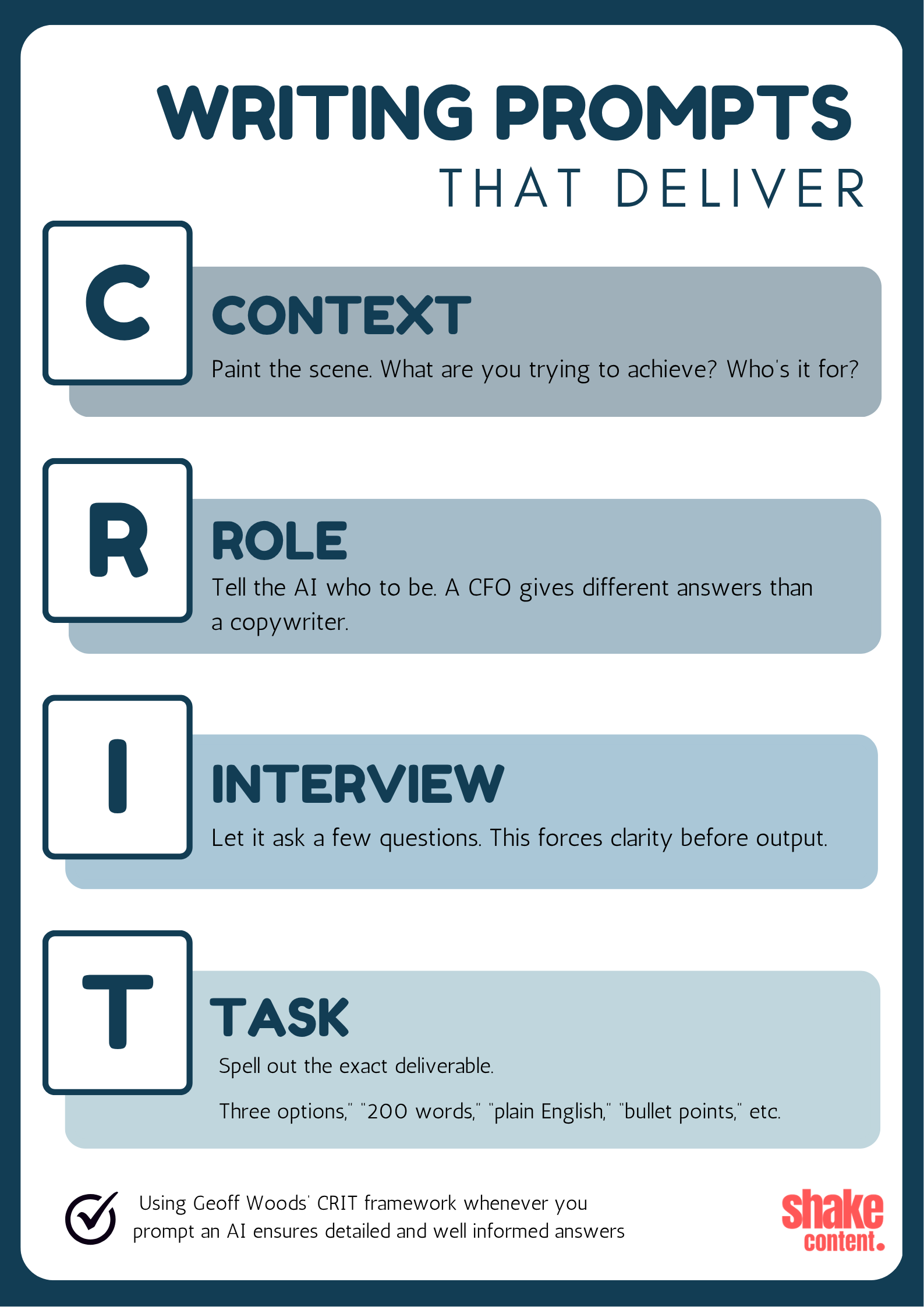
The CRIT Method is a structured approach to turning real founder thinking into consistent LinkedIn content. It removes guesswork from the process and replaces it with a clear path from idea to execution.
Instead of asking what to post, founders follow a sequence that mirrors how they already think and operate.
Every strong piece of content starts with a real situation. This could be a decision, a conversation, a recurring challenge, or a pattern observed in the market.
Context answers a simple question: why does this insight matter right now?
Grounding content in reality makes it immediately more relevant and easier for the audience to connect with.
Raw input captures thinking before it is refined. This might be a voice note, a rough paragraph, or a quick internal message.
At this stage, speed matters more than quality. The goal is to preserve the idea while it is still fresh, without overthinking structure or wording.
Insight is where authority is built. This is the layer where experience is translated into a clear point of view.
It often comes from recognising patterns, challenging assumptions, or articulating something that is not immediately obvious from surface-level advice.
Without insight, content may generate engagement, but it will not build lasting credibility.
Transformation is where the idea becomes a LinkedIn-ready post. This involves shaping the structure, refining clarity, and aligning tone while preserving the original thinking.
The goal is not to polish the idea into something generic. It is to make it clear, readable, and impactful without losing its edge.
A content engine is not built through volume. It is built through repeatability.
The CRIT Method works because it connects three key components of a sustainable LinkedIn content strategy.
Inputs already exist inside the business. These include customer conversations, internal debates, strategic decisions, and lessons learned through execution.
Process is where CRIT operates. It defines how those inputs are captured, developed, and shaped into insight.
Outputs are the visible results. Consistent, high-quality posts that feel intentional and grounded in real experience.
When these three elements are aligned, content stops feeling like a separate task. It becomes a natural extension of how founders already think and operate.
AI is often positioned as a shortcut for content creation. In practice, this is where it delivers the least value.
Without structure, AI produces content that sounds polished but lacks depth and originality.
Within a framework like CRIT, AI becomes significantly more useful.
It can help expand raw input, organise context, and accelerate the development of ideas. It can also support transformation by improving clarity and structure.
However, the core insight must remain human. That is what builds trust, authority, and differentiation in B2B storytelling.
The role of AI is to reduce friction, not replace thinking.
For a content system to work, it must fit into real founder schedules. It cannot rely on long writing sessions or dedicated content blocks.
A simple daily workflow might look like this:
Because this process mirrors how founders already operate, it integrates naturally into the day rather than competing with it.
Over time, consistency builds without additional pressure, and content begins to compound.
Burnout in content creation rarely comes from writing itself. It comes from repeated decision-making.
Constantly asking what to say, how to say it, and whether it is worth posting creates unnecessary cognitive load.
The CRIT Method removes that friction by providing a clear, repeatable path.
Instead of relying on motivation, founders rely on structure. Instead of starting from zero, they move through a familiar process.
This is what allows LinkedIn personal branding to scale alongside the business rather than compete with it.
Consistency comes from having a structured workflow rather than relying on inspiration. Frameworks like the CRIT Method turn everyday thinking into repeatable content.
No. AI can support content workflows, but the insight must come from real experience to build trust and authority.
Consistency matters more than frequency. A structured system allows founders to maintain a regular presence without unnecessary pressure.
Drop your email to receive the CRIT Method cheat sheet in your inbox and start using it to turn your daily thinking into a consistent LinkedIn content engine.


