
LinkedIn marketing can start producing encouraging signals within the first few weeks, but meaningful B2B results usually take longer.
For most brands, the first one to three months are about building consistency, testing positioning and learning what resonates with the right audience. Between three and six months, stronger patterns can begin to emerge around reach, recognition, engagement and inbound interest. Building sustained authority and a reliable source of commercial opportunities is usually a longer-term process.
That timeline is not fixed. A founder with an established network and strong point of view may gain traction faster than a company starting from scratch. Content quality, positioning, publishing frequency and the strength of the underlying strategy all affect how quickly results appear.
The more useful way to look at LinkedIn marketing is to understand what progress should look like at each stage.
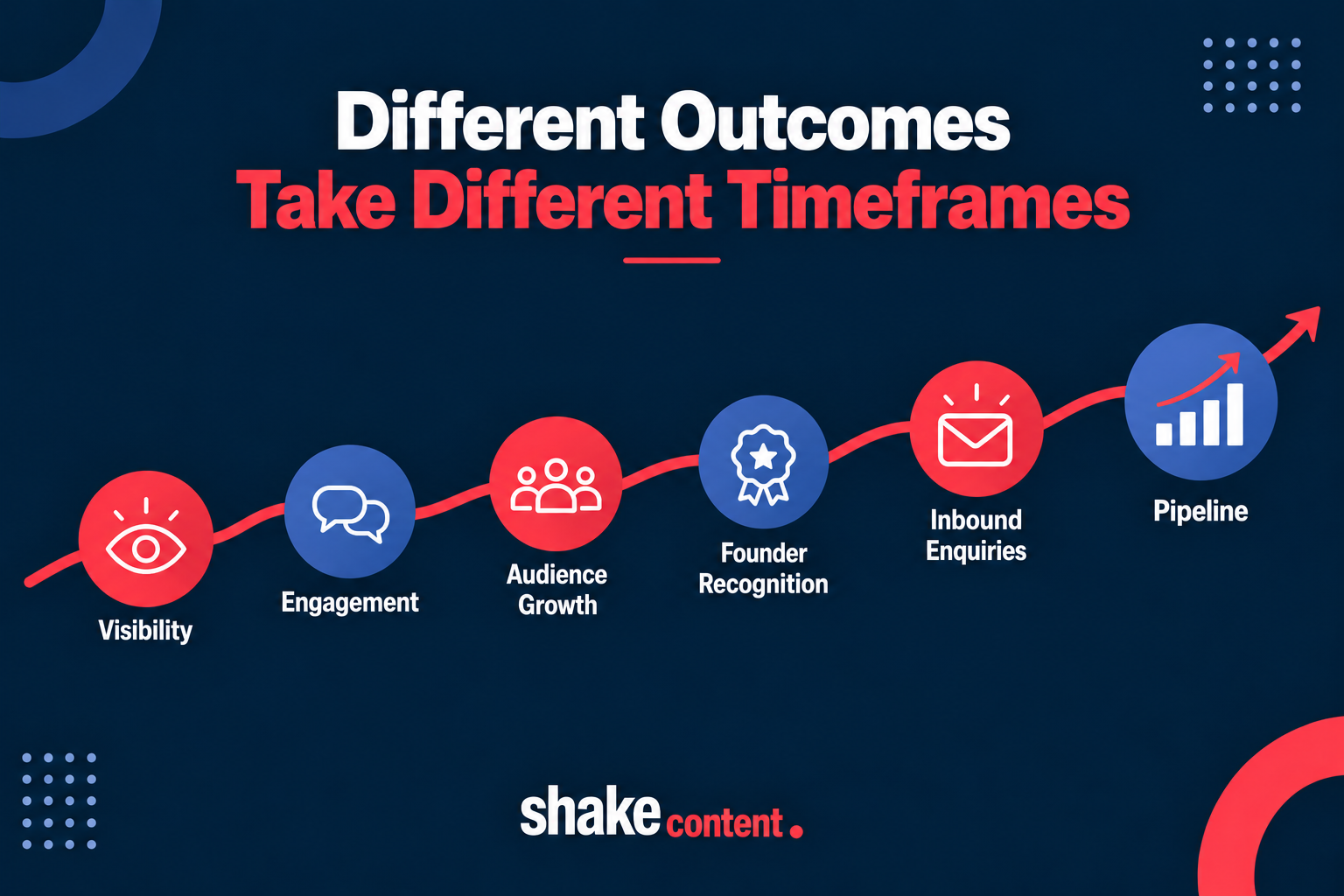
Before setting a timeline, it helps to define the result you are trying to generate. LinkedIn marketing can contribute to several outcomes, including increased visibility, stronger engagement, audience growth, founder or executive recognition, inbound enquiries and ultimately pipeline.
Those outcomes don’t normally arrive at the same time. A post might generate more profile views within days. Consistent publishing might lead to greater recognition within several weeks. A prospect mentioning your content during a sales conversation could take months.
This is especially important in B2B, where content often influences a buying journey rather than producing an immediate conversion. LinkedIn can help a company become familiar and credible before a potential buyer is actively looking for its services.
Having a clear B2B LinkedIn strategy makes it much easier to determine which results actually matter and how they should be measured over time.
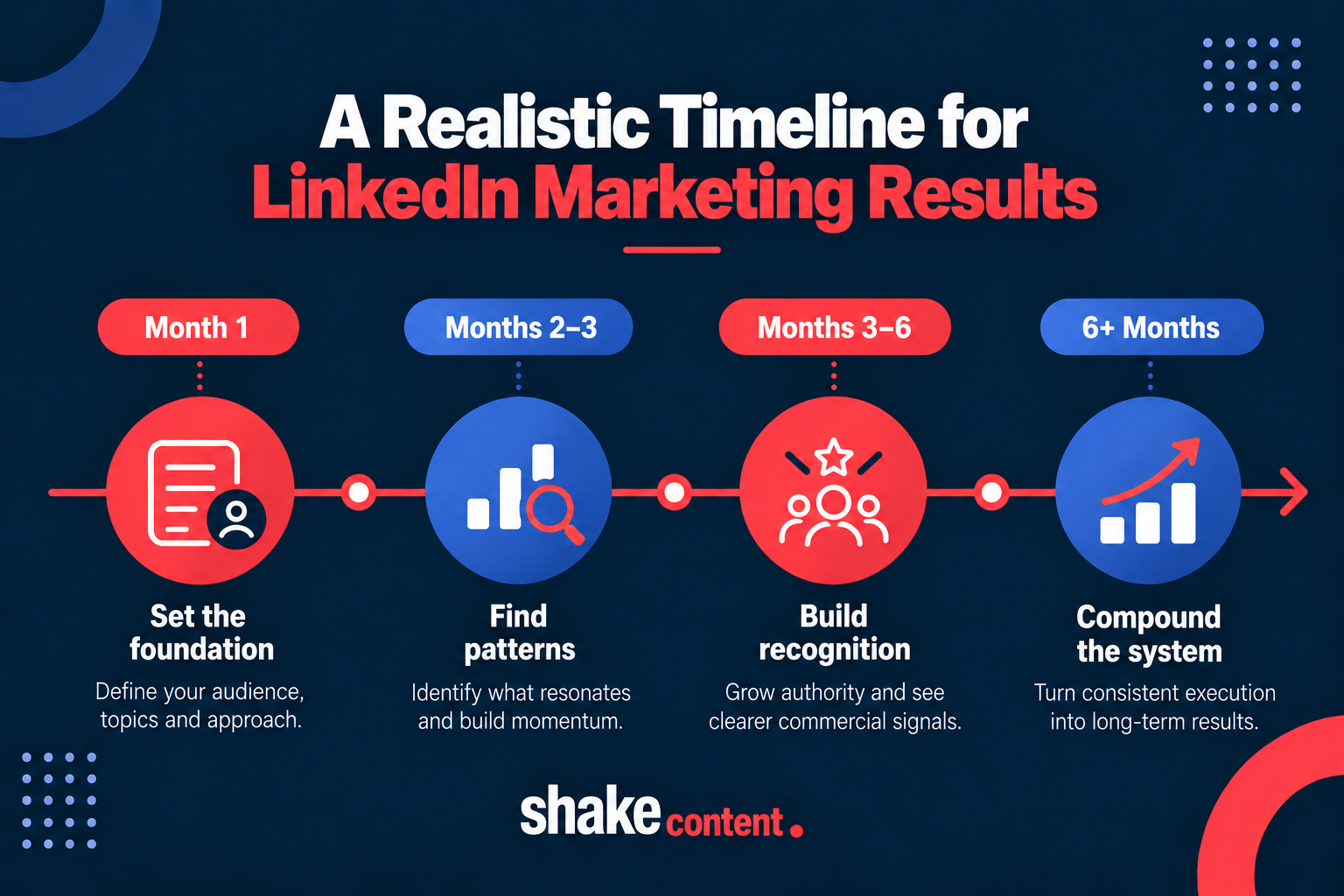
There is no universal LinkedIn marketing timeline, but progress can broadly be understood across four stages.
The first few weeks should primarily establish direction. This means defining who the content needs to reach, what the founder or brand wants to be known for, which topics it can credibly own and how frequently it can publish without sacrificing quality.
Early performance can still provide useful signals. Certain topics may generate more comments. Some formats may attract the right people to a profile. A founder may begin receiving more relevant connection requests.
But these signals should be treated as learning rather than proof that the strategy has succeeded or failed. One strong post is not enough data to judge an entire LinkedIn strategy.
Once content has been published consistently for several weeks, patterns become easier to identify. You can start seeing which themes repeatedly attract the right audience, which perspectives generate useful conversations and which formats deserve further development.
Recognition may also begin to grow. People who have encountered several posts from the same founder or company start becoming familiar with its ideas and positioning.
This is where LinkedIn posting frequency makes all the difference. Publishing enough to create repeated exposure is useful, but increasing volume at the expense of relevance rarely accelerates meaningful progress. The objective is to establish momentum that can be sustained.
This is often where a strong LinkedIn content strategy becomes more visible as a system rather than a collection of individual posts. Themes have had time to develop. The audience has encountered the founder or brand repeatedly. Stronger ideas can be revisited from different perspectives rather than constantly replaced.
Commercial signals may also become clearer. Prospects might reference content during conversations, relevant people may begin engaging regularly, and inbound enquiries can emerge from people who have followed the content for some time.
That is one reason consistency over virality matters in B2B LinkedIn marketing. B2B thought leadership is built through accumulated exposure, not a single spike in impressions.
A mature LinkedIn presence should become easier to learn from over time.
The team has more performance data, a clearer understanding of its strongest themes and a growing library of ideas that can be expanded, repurposed or connected. More importantly, the audience has had time to develop familiarity with the people and ideas behind the brand.
At this point, LinkedIn can increasingly function as a long-term authority and demand-generation channel rather than simply a publishing platform. That doesn’t mean results become automatic after six months. Weak positioning or generic content will not improve simply because more time passes. The advantage comes when consistent execution is paired with ongoing learning.
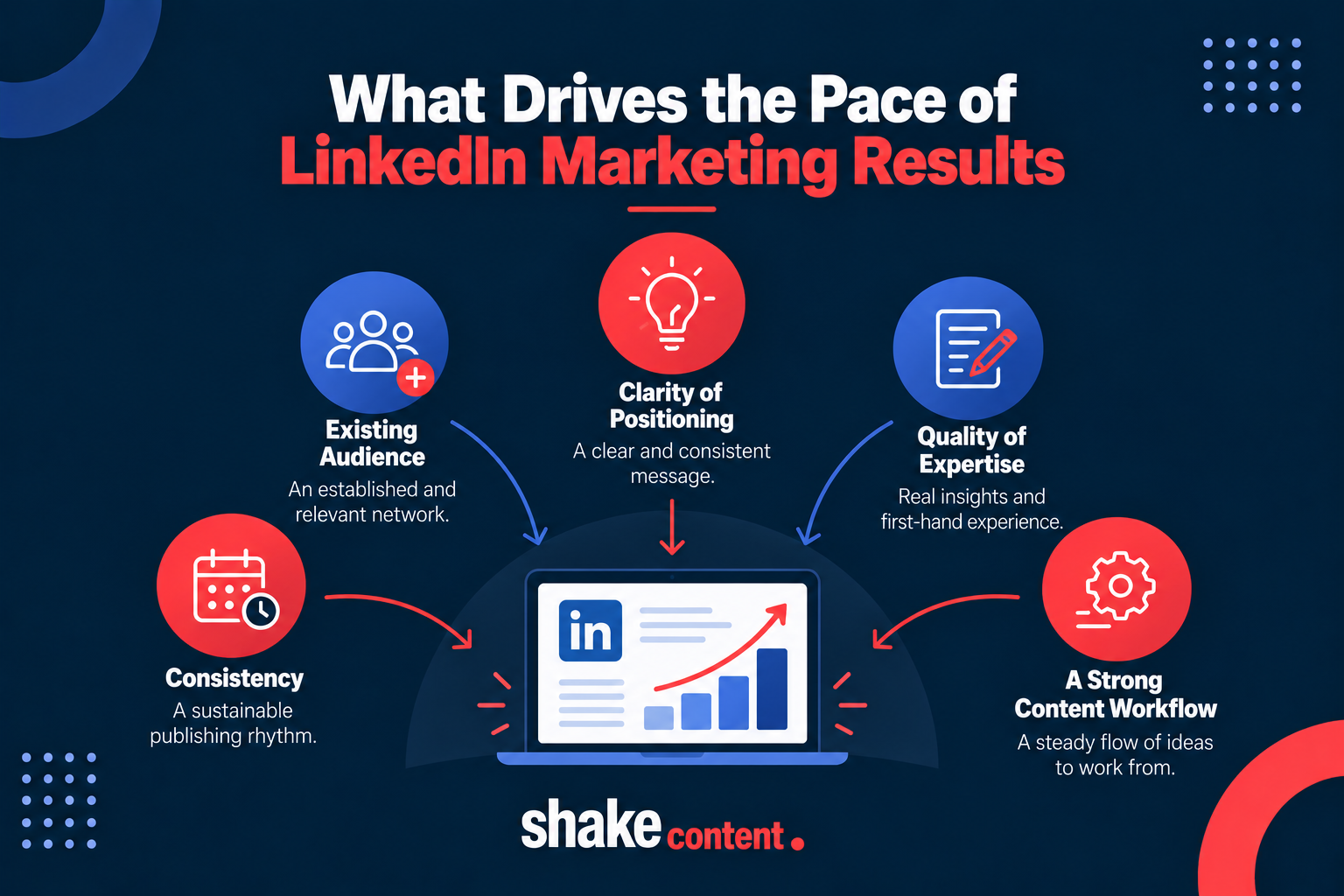
Two companies can start posting on LinkedIn on the same day and experience very different results six months later. Several factors affect the speed of progress.
A founder with an established professional network already has some distribution and recognition. Someone building a presence from zero needs more time to establish both.
The relevance of that network matters too. A smaller audience made up of potential buyers, peers and industry decision-makers can be more valuable than a much larger but less relevant following.
Content compounds more effectively when the audience can quickly understand what someone knows and why their perspective is relevant.
Constantly moving between unrelated topics makes that association harder to build. Clear positioning gives repeated content a common thread and helps founders or brands become associated with particular areas of expertise.
Strong B2B LinkedIn content usually starts with something worth communicating.
First-hand lessons, customer conversations, industry observations and informed opinions give content more substance than generic advice. Using B2B storytelling techniques can help turn that expertise into content people actually want to read without reducing complex ideas to superficial social media takes.
Publishing for three weeks, disappearing for a month and returning with a burst of posts makes it difficult to build momentum.
A sustainable rhythm creates repeated opportunities for the right audience to encounter your thinking. That consistency also produces more useful performance data, making it easier to understand what is actually working.
Consistency is much easier when ideas are captured and developed systematically.
Founders should not need to invent three new LinkedIn topics every Monday morning. Customer conversations, internal discussions, sales calls, industry observations and existing expertise can all feed a structured content engine.
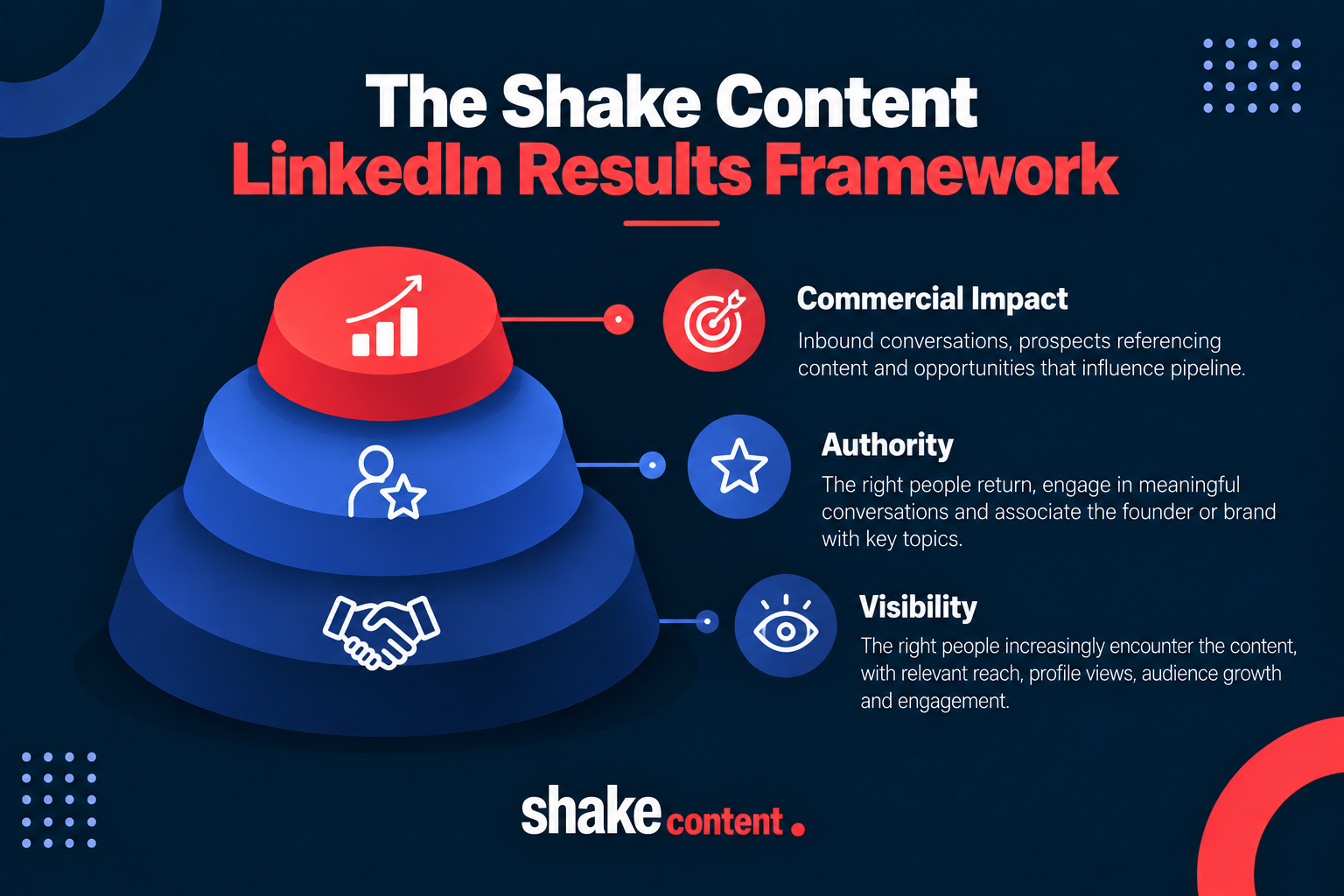
Rather than evaluating LinkedIn solely by how many leads arrived in a particular month, Shake Content looks at progress across three connected layers: visibility, authority and commercial impact.
Visibility asks whether the right people are increasingly encountering the content. Relevant reach, profile views, audience growth and engagement can help indicate whether distribution is developing.
Authority looks at what happens once people encounter the content repeatedly. Are the right people returning? Are posts generating substantive conversations? Is the founder becoming associated with the subjects the business wants to own?
Commercial impact looks further down the line. This includes inbound conversations, prospects referencing content, opportunities influenced by LinkedIn and eventually pipeline.
The layers build on each other. Commercial impact becomes much harder to generate consistently when visibility and authority have not had time to develop. That is why judging a LinkedIn programme purely on leads after its first few weeks can give a misleading picture of performance.
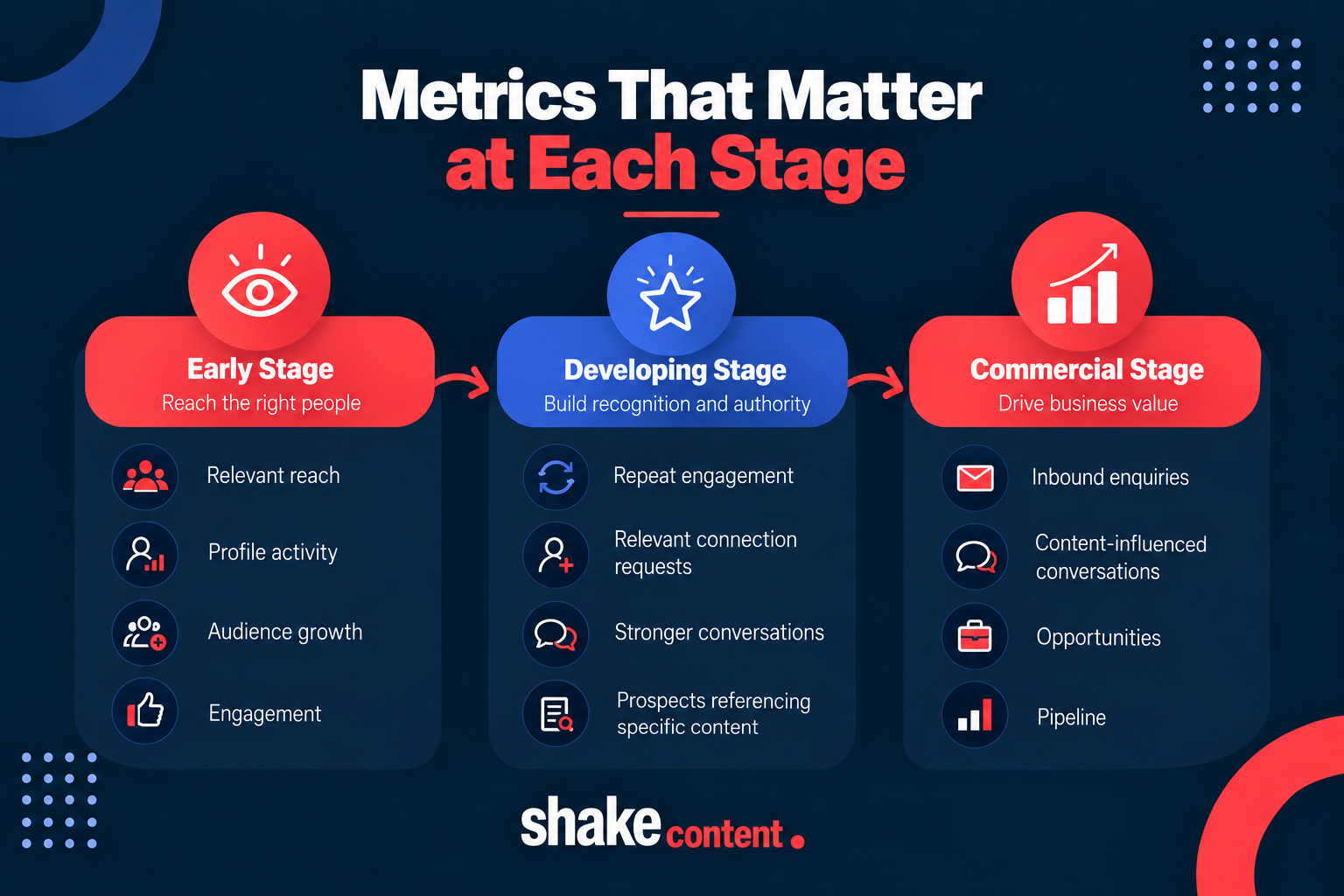
Measuring LinkedIn performance requires more than tracking impressions or waiting for leads to appear. The metrics that matter depend on what the content is currently trying to achieve.
Early on, relevant reach, profile activity, audience growth and engagement can help show whether the content is reaching the right people. The quality of those signals matters as much as their volume. Engagement from potential buyers, peers and industry decision-makers can tell you more than a large number of interactions from an unrelated audience.
As the programme develops, look for signs of growing authority. Repeat engagement, relevant connection requests, stronger conversations and prospects referencing specific content can indicate that the audience is becoming more familiar with the founder or brand.
Commercial metrics become increasingly useful once that foundation exists. Inbound enquiries, content-influenced conversations, opportunities and pipeline can help show whether visibility and authority are translating into business value.
The goal is to measure progress according to the maturity of the programme rather than expecting every metric to improve at once.
LinkedIn content is easy to judge post by post because every post comes with immediate numbers. That can distort how B2B marketing actually works. A prospect might see one post without engaging. Two weeks later, they encounter another. They visit the founder's profile after a third, then recognise the name when someone recommends the company months later.
None of those individual interactions necessarily looks significant in analytics. Together, they can influence a commercial decision.
A post with modest engagement may still reach exactly the right people, while a high-performing post may attract attention from an audience that has little commercial relevance. Looking at individual posts in isolation can therefore make it harder to understand whether the broader LinkedIn strategy is actually building momentum.
The aim is to create a content system in which each post reinforces the next.
Shake Content helps B2B founders, leaders and teams build LinkedIn thought leadership through strategic content systems and personalised frameworks. The focus is on turning internal expertise into a repeatable content engine that can build visibility, authority and commercial relevance over time.
A lead can technically arrive after the first post, but that should not be treated as a predictable timeline. Consistent inbound lead generation generally requires enough time to establish visibility, credibility and relevance with the target audience.
Three months can provide enough content and performance data to identify useful patterns, particularly if publishing has been consistent. It is less reliable as a deadline for determining the full commercial impact of a long-term B2B content strategy.
There is no single posting frequency that guarantees results. The right cadence is one the business can sustain while maintaining relevance and quality. Consistency matters more than hitting an arbitrary daily posting target.
Consistency alone cannot compensate for weak positioning or generic content. If performance remains flat, review whether the content is reaching the right audience, communicating a recognisable area of expertise and providing perspectives that are genuinely useful.
It can, particularly when a founder already has a relevant network and clear expertise. Founder-led content gives B2B businesses a human voice through which to communicate experience and perspective, but it still requires a clear strategy and consistent execution.
Usually, a month is too short a period to judge LinkedIn purely by lead generation. Look at earlier indicators such as relevant reach, profile activity, audience quality, engagement and conversations before assessing longer-term commercial impact.


