
You have been posting consistently on LinkedIn. Some posts get a healthy number of impressions, others barely move. A few people comment regularly, follower numbers are increasing, and occasionally someone mentions seeing your content.
But how do you know if LinkedIn is actually working for your business?
For B2B founders and marketing teams, this is harder to answer than it should be. LinkedIn provides plenty of analytics, but those numbers do not necessarily tell you whether your content is helping you achieve your business goals.
A post with 50,000 impressions could reach almost nobody relevant to your company. Another with 3,000 impressions could put your expertise in front of several potential customers.
Understanding LinkedIn performance requires looking beyond individual posts and measuring how your visibility, authority and commercial impact develop over time.
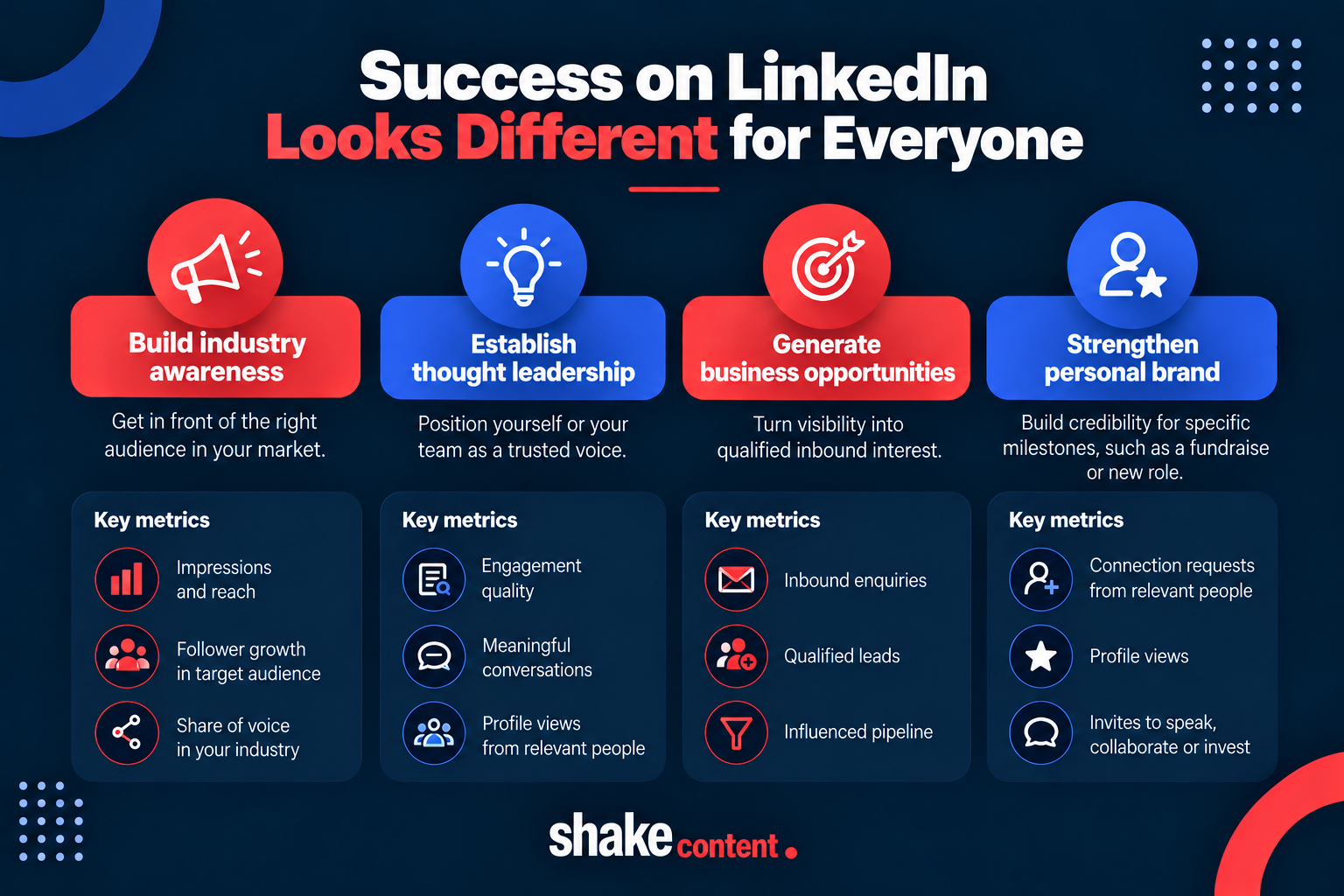
Before measuring LinkedIn performance, you need to establish what you expect the platform to achieve.
A founder trying to become better known within a particular industry should measure LinkedIn differently from a SaaS company primarily interested in generating demos. Similarly, a CEO building credibility ahead of a fundraise will have another definition of success.
Your primary objective might be increasing awareness among a specific audience, building B2B thought leadership, generating qualified inbound opportunities or strengthening LinkedIn personal branding.
This is why having a clear B2B LinkedIn strategy matters before measurement begins. Without defined objectives, almost any metric can look encouraging while telling you very little about actual progress.
Once you understand what you want LinkedIn to achieve, you can identify the indicators that demonstrate whether your content is moving you closer to those goals.
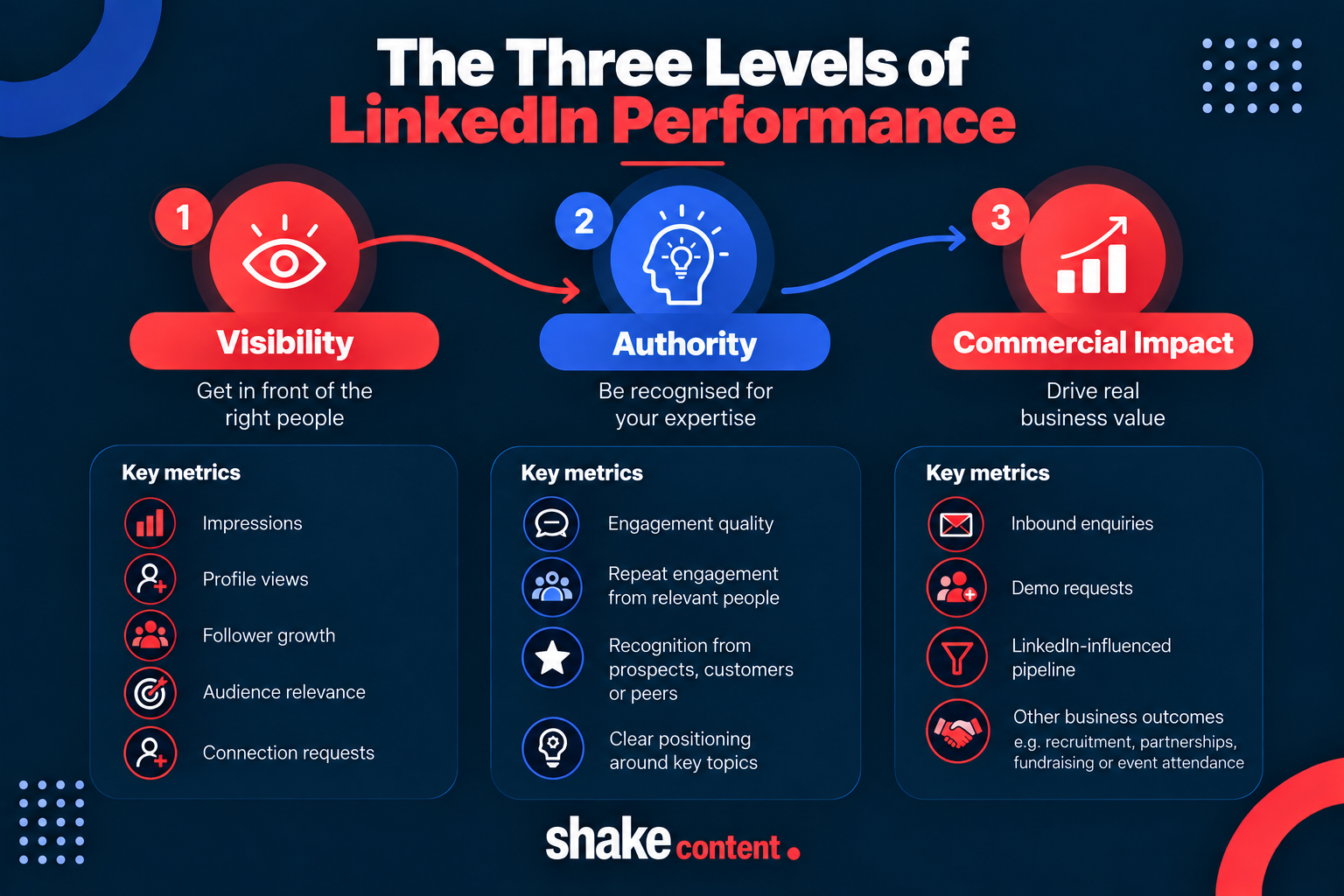
LinkedIn performance can be assessed across three connected levels: visibility, authority and commercial impact. Each provides a different perspective on how effectively your content is reaching people, influencing perceptions and contributing to business objectives.
These levels often develop progressively. People generally need to encounter your content before they become familiar with your expertise, and that familiarity can develop into commercial interest over time.
Visibility is often the earliest indication that your LinkedIn content strategy is gaining traction.
Impressions are useful here, but they need context. Rather than simply asking whether reach increased, consider whether your content is increasingly reaching the audience you want to influence.
Useful visibility metrics include:
Audience quality matters considerably. If you sell enterprise software to financial services companies, 100 interactions from people outside your market may be less valuable than ten interactions from banking executives.
You should also examine trends rather than individual posts. One unusually successful post can distort your view of performance, while several months of improving reach among relevant audiences provide a more reliable indication of progress.
This is one reason consistency matters more than chasing virality. B2B visibility generally develops through repeated exposure to relevant ideas, allowing audiences to become familiar with your expertise over time.
Visibility introduces your content to potential audiences, but authority develops when people begin associating you with particular topics, perspectives or areas of expertise.
This stage can be harder to measure because some of its strongest indicators are qualitative. While LinkedIn analytics can show how many people interacted with a post, they cannot fully explain whether those interactions changed someone's perception of your expertise.
Look at who repeatedly engages with your content and the conversations happening in the comments. You might notice prospects referencing something you published weeks earlier, customers mentioning your posts during meetings or industry professionals inviting you to contribute to discussions.
These interactions suggest that your LinkedIn presence is building recognition beyond individual posts. Your content should also reinforce a relatively clear set of ideas. If you publish regularly but your audience cannot identify what you are knowledgeable about, increasing visibility may not translate into stronger positioning.
This is particularly important for founder-led marketing, where strong founder-led LinkedIn content can help establish a recognisable perspective through personal experiences, industry observations and informed opinions.
Over time, the strongest indication of authority is that relevant people begin approaching you because they already understand what you know and why your perspective matters.
Eventually, LinkedIn should contribute to outcomes that matter beyond the platform itself. However, measuring that contribution requires understanding how B2B buying decisions happen.
A potential customer might follow a founder for months, read several posts, visit the company website, meet the team at an event and eventually respond to a sales email. LinkedIn may have influenced that journey even if traditional attribution tools cannot connect the opportunity to a particular post.
This is why commercial measurement should include more than direct LinkedIn leads.
Relevant indicators include inbound enquiries, demo requests, prospects mentioning content during sales conversations, LinkedIn-sourced opportunities and pipeline where LinkedIn contributed to the relationship. You can also introduce simple attribution questions into your sales process. Asking prospects how they first discovered the company or whether they have encountered its LinkedIn content can reveal influence that website analytics might otherwise miss.
For some businesses, commercial impact may involve recruitment, partnerships, fundraising or event attendance rather than immediate sales. The important consideration is whether LinkedIn is contributing to the business objectives established at the beginning of your strategy.
One of the most common mistakes in LinkedIn measurement is treating every post as an independent success or failure based on engagement. A post receiving 40 likes might appear successful, while another receiving eight could be considered disappointing. However, those numbers reveal very little about the role each post plays within a wider content strategy.
A highly technical post might attract fewer reactions but strengthen credibility among a small group of ideal buyers. A broader industry observation could generate greater reach and introduce your expertise to new audiences. Meanwhile, a customer story might help an existing prospect understand how your company solves a particular problem.
Each type of content serves a different purpose, which means performance should be assessed against its intended contribution.
Rather than evaluating posts individually, review patterns across several weeks or months. Identify which subjects attract relevant audiences, which formats encourage meaningful discussions and which perspectives generate repeated interest.
If engagement remains consistently weak, consider whether your expertise is being communicated effectively. Using stronger B2B storytelling techniques can help make complex ideas more accessible while maintaining the depth that makes them valuable.
LinkedIn needs sufficient time and consistency to produce meaningful performance indicators. Publishing for two weeks and stopping because no leads have appeared provides little insight into whether the strategy could succeed.
Early signals such as impressions, engagement and profile activity can emerge relatively quickly. However, building authority and generating commercial opportunities generally requires sustained publishing because these outcomes depend on repeated exposure and growing familiarity.
A useful approach is to review early performance after the first month, examine audience and engagement patterns over the following two to three months, and evaluate longer-term commercial influence as more evidence becomes available.
These periods are practical review checkpoints rather than guaranteed timelines. Results will depend on your starting audience, content quality, industry, posting frequency and the strength of your positioning.
Maintaining a consistent LinkedIn posting frequency also makes performance easier to evaluate because it provides a more reliable body of content from which to identify patterns.
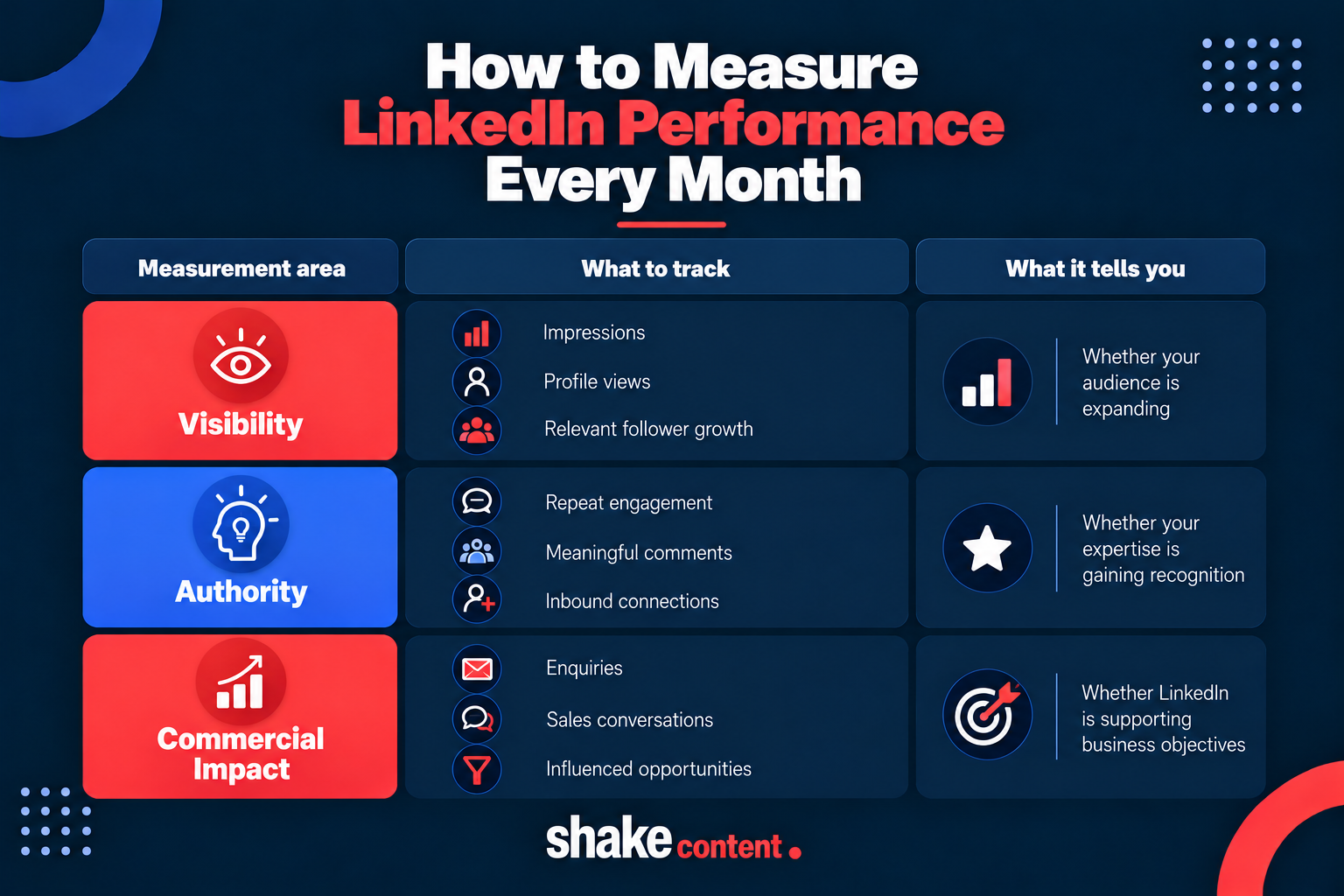
You do not need a complicated reporting dashboard to understand whether LinkedIn is moving in the right direction. A structured monthly review can provide enough information to identify progress and make informed improvements.
Start by comparing performance against the previous month and, where possible, a longer baseline. Focus on changes in audience quality, engagement behaviour and business outcomes rather than relying exclusively on percentage increases.
Alongside these metrics, examine the content itself. Which topics generated the most relevant conversations? Did certain formats encourage more profile visits? Are prospects increasingly mentioning ideas shared through your posts?
The answers should inform the following month's content strategy, helping you refine your positioning, identify effective themes and improve how your expertise is communicated.
If performance remains flat over several months, publishing more frequently may not address the underlying problem.
Start by reviewing whether your content is reaching a clearly defined audience and whether the subjects you discuss reflect their actual interests and challenges. Content that attracts engagement from the wrong people may indicate a positioning or distribution issue.
Next, examine the quality of the ideas being shared. Posts that repeat familiar industry observations without adding experience, evidence or a distinctive perspective may struggle to build meaningful authority.
Finally, consider whether your content is connected to a wider business objective. A company focused on generating qualified leads needs a strategy that demonstrates expertise relevant to its buyers, rather than simply publishing general industry commentary.
Measure visibility, authority and commercial impact together. Relevant reach, audience growth, meaningful conversations and business opportunities provide a more complete picture than engagement metrics alone.
Impressions help measure visibility, but they do not indicate whether your content is reaching the right audience or influencing business outcomes.
Early engagement signals can appear within weeks, while meaningful authority and commercial results often require several months of consistent activity.
Yes, but consider who is engaging and whether those interactions contribute to your objectives. The quality of engagement is often more informative than the total number.
Yes. LinkedIn may be improving brand awareness, professional credibility and sales relationships before those effects translate into directly attributable leads.
Monthly reviews are generally sufficient for identifying patterns, with quarterly assessments providing a broader view of strategic and commercial progress.


