
Choosing between a LinkedIn Marketing agency and an in-house team is rarely a simple question of cost. It’s a decision about capability, speed, access to expertise, and how much internal time your business can realistically dedicate to building a consistent presence.
For B2B companies, LinkedIn is often where buyers form early opinions, potential hires assess leadership, and industry credibility is built long before a sales conversation begins. That makes the quality and consistency of your content far more important than simply posting regularly.
The right model depends on where your business is today, what you want LinkedIn to achieve, and whether you already have the people, systems, and strategic direction to make it work.
Shake Content helps B2B founders, teams, and leaders build LinkedIn thought leadership through strategic content systems and personalised frameworks. In this guide, we break down the difference between working with a LinkedIn Marketing agency and building an in-house team, so you can choose the model that best supports your growth.
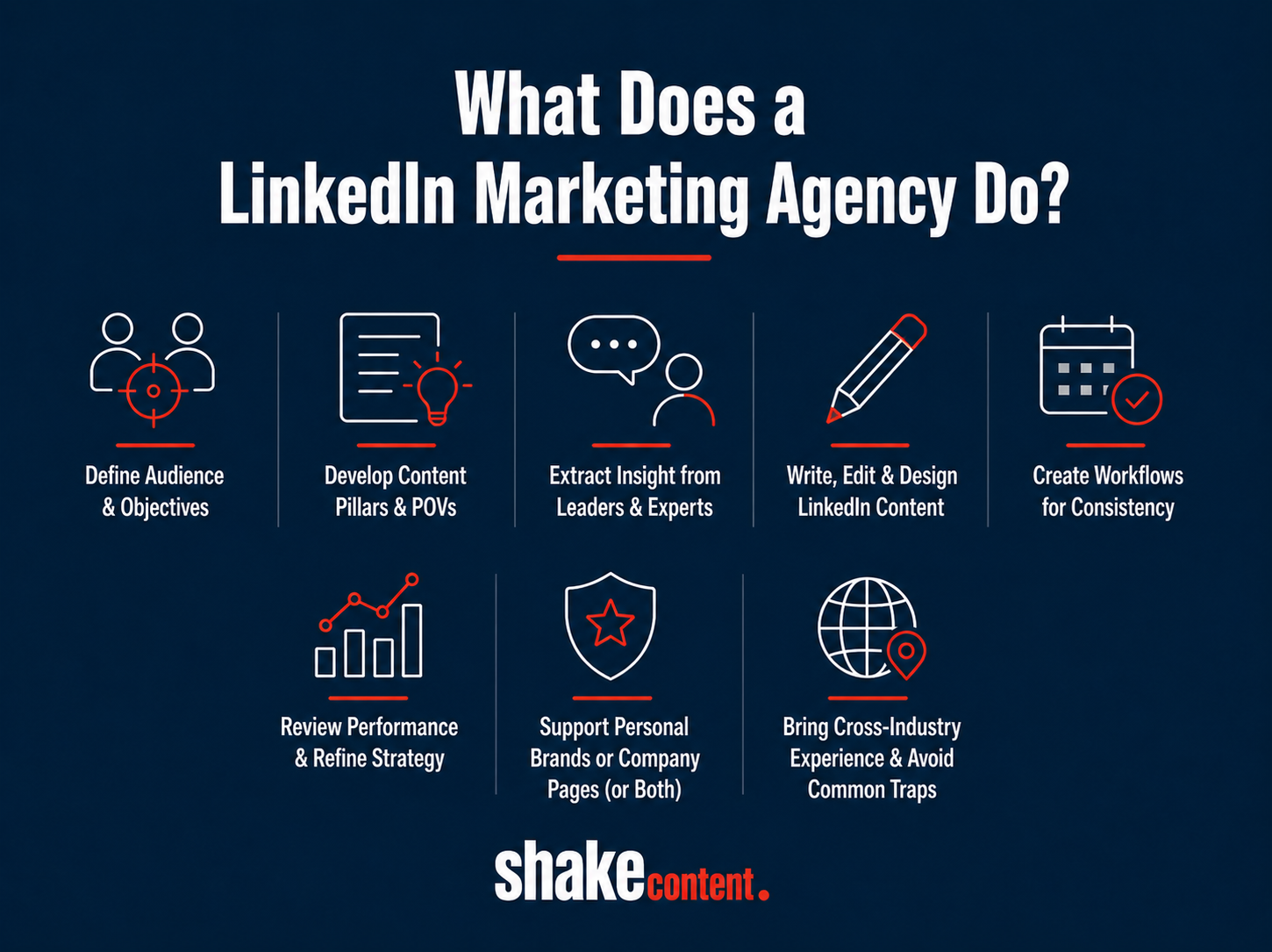
What LinkedIn Marketing agencies actually do goes beyond publishing posts. They create, manage, and improve a business’s LinkedIn content strategy, from defining content pillars and extracting founder insight to producing content, managing workflows, and refining performance over time.
The best agencies do more than write posts. They turn founder expertise, commercial insight, customer conversations, and industry experience into a repeatable content system that builds authority over time.
That usually includes:
A specialist agency can also bring experience from multiple industries and content programmes. That matters because it helps teams avoid the usual traps: publishing generic advice, relying on inconsistent founder input, or measuring success only through likes.
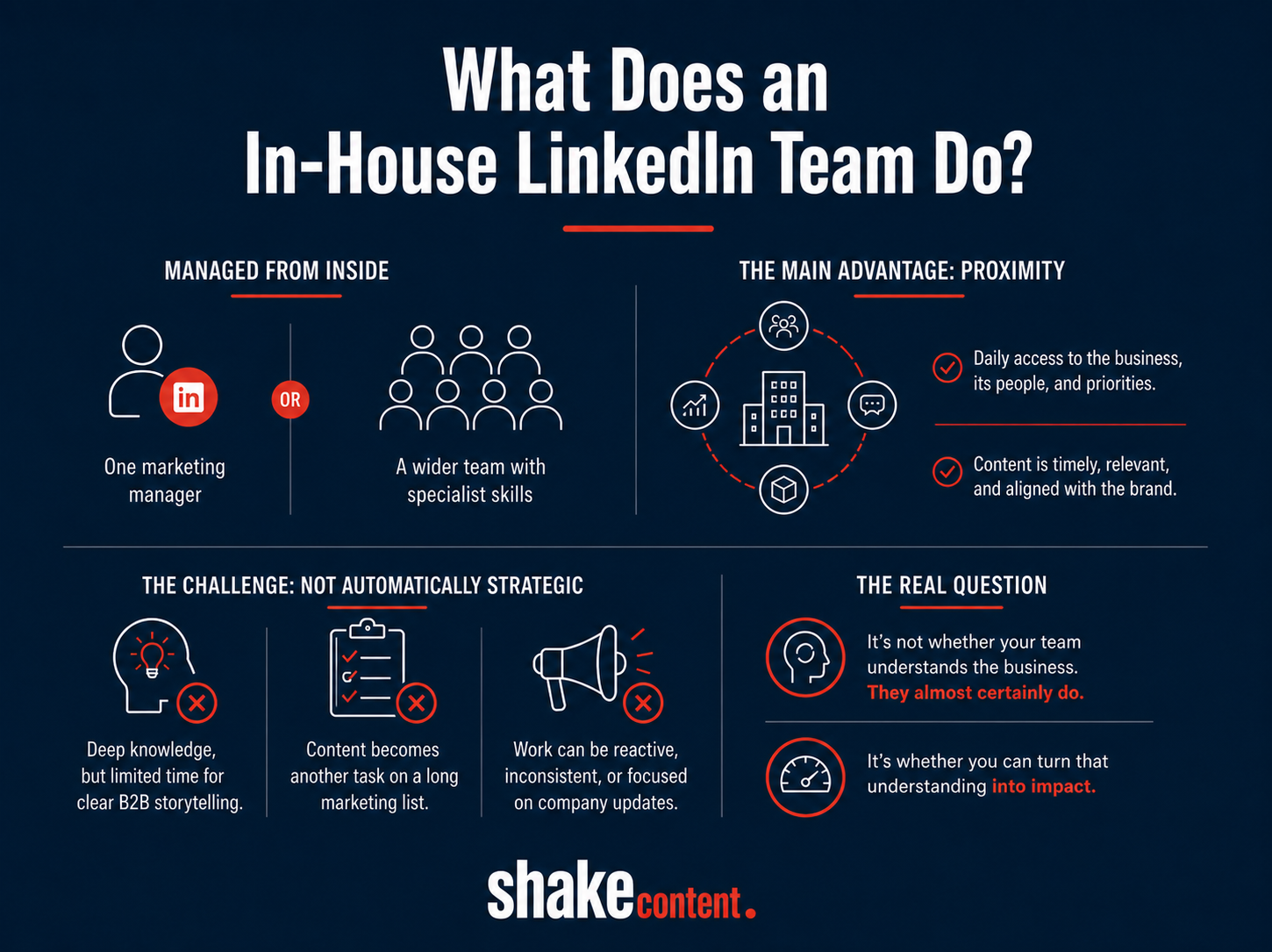
An in-house LinkedIn team manages content from inside the business.
This could mean one marketing manager who owns LinkedIn alongside several other channels. It could also mean a wider team that includes a strategist, copywriter, designer, video specialist, community manager, and marketing leader.
The main advantage is proximity.
An internal team has daily access to the business, its people, product developments, customer feedback, and commercial priorities. When the right processes are in place, that can make content highly timely and closely aligned with the wider brand.
However, in-house does not automatically mean strategic.
Many internal teams have deep company knowledge but limited time to turn that knowledge into clear B2B storytelling. LinkedIn content often becomes another task on a long marketing list, which means the work is reactive, inconsistent, or overly focused on company updates.
The question is not whether your team understands the business. They almost certainly do. The question is whether they have the dedicated capacity, content expertise, and operating rhythm to turn that understanding into a strong LinkedIn presence.
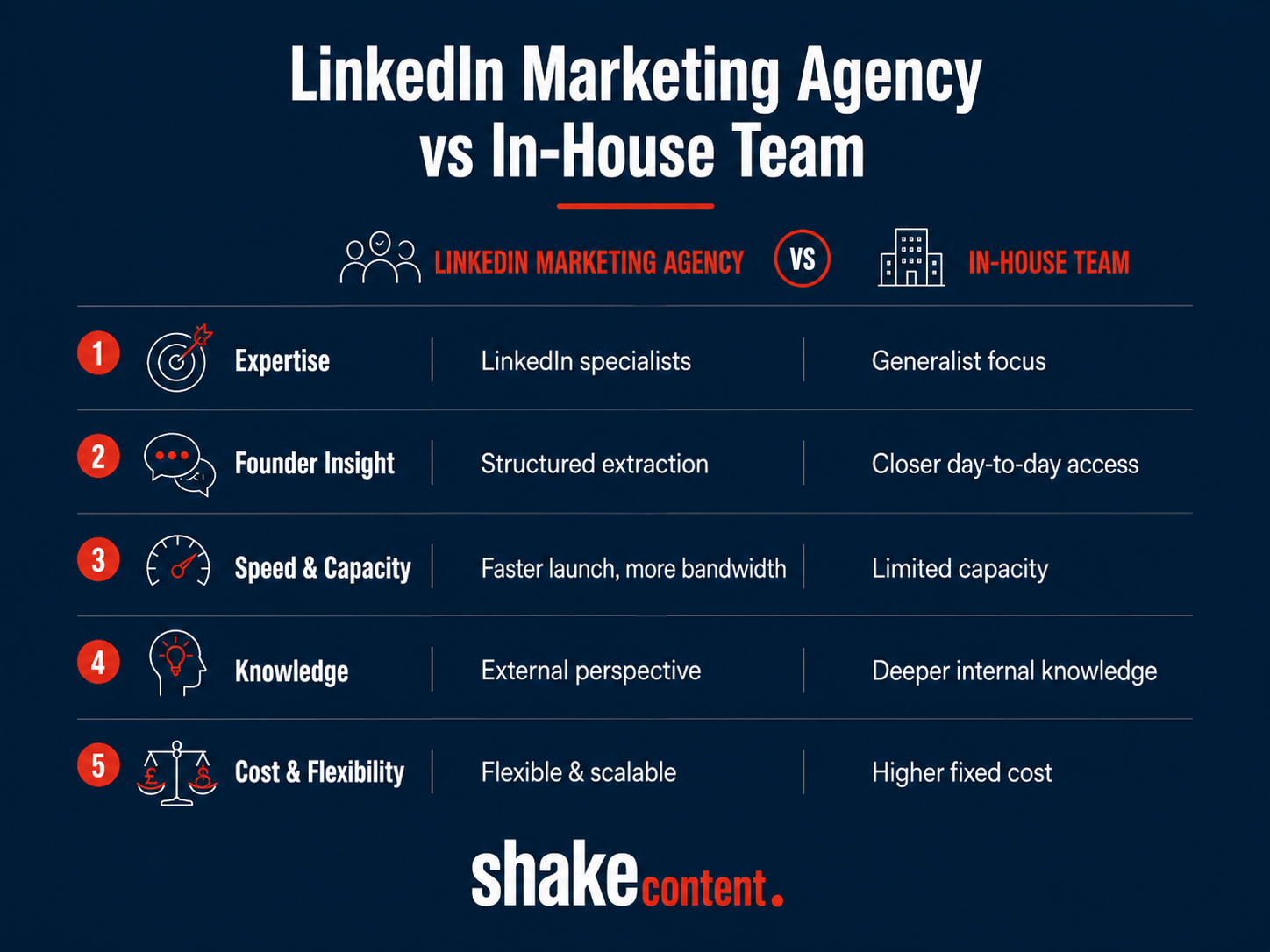
The decision usually comes down to five areas.
A LinkedIn Marketing agency brings specialist experience.
It has seen the patterns that make B2B thought leadership work across different founders, markets, and growth stages. It understands how to position a founder’s expertise, create content pillars that build recognition, and turn scattered ideas into a connected LinkedIn content strategy.
An in-house team may have strong broader marketing skills, but LinkedIn often requires a different approach. The best content is not simply repurposed from a blog, sales deck, or company announcement. It needs a clear point of view, a recognisable voice, and enough consistency to compound over time.
An agency is usually the stronger option when your business needs specialist direction quickly.
An in-house team can be the stronger option when you already have experienced content strategists who understand B2B thought leadership and have the time to focus on it properly.
Founder-led content works when it reflects real experience rather than polished generic messaging.
An in-house team may find it easier to access leaders informally. They are in the same meetings, hear the internal conversations, and understand what is happening across the business.
A good Founder Brand agency solves this differently. It creates structured ways to extract insight without demanding hours of preparation from the founder. That might include short interviews, voice notes, weekly calls, or content workflows that capture useful ideas while they are still fresh.
The difference is often in the process.
Without a reliable way to capture founder thinking, even the most knowledgeable internal team can struggle to produce enough original content. This is where a structured approach such as The CRIT Method, for example, can help turn raw expertise into a consistent content engine.
An in-house team can move quickly on immediate company news, launches, and events.
But capacity is often the limiting factor.
LinkedIn content requires more than drafting a post. There is strategy, research, founder input, writing, editing, design, approvals, scheduling, engagement, and performance review. When one person owns all of that alongside email, paid media, events, product marketing, and internal requests, LinkedIn is usually the first thing to become inconsistent.
A LinkedIn Marketing agency gives you dedicated capacity without needing to hire multiple specialists. The agency can manage the full content workflow while your internal team focuses on commercial priorities and provides the context only they can provide.
An agency is usually more efficient when you need to build momentum quickly without creating a new internal function.
In-house teams naturally have deeper day-to-day knowledge of the business.
They know the product language, internal priorities, customer stories, and nuances that an external partner needs time to learn. This can be particularly valuable in technical sectors, highly regulated industries, or businesses with complex products.
However, deep knowledge can sometimes create a different problem.
Teams that are too close to the business can find it harder to identify what is genuinely interesting to an external audience. They may default to internal terminology, product updates, or messages that make sense inside the company but do not create a reason for a buyer to stop scrolling.
An external agency can bring useful distance. It can identify the stories, patterns, and insights that are obvious to your team but valuable to your audience.
The strongest model often combines both: internal expertise and external editorial judgement.
Hiring in-house means paying for more than salary.
You may need a strategist, writer, designer, video producer, social media manager, and marketing lead depending on the scale of your ambitions. You also need time for onboarding, management, tools, and process development.
An agency can give you access to a broader set of skills through one partner. This is often more flexible for businesses that want to test LinkedIn as a growth channel, scale activity around a launch, or build authority before committing to a larger internal team.
In-house hiring can make more sense when LinkedIn is already a proven strategic channel and there is enough ongoing work to justify dedicated roles.
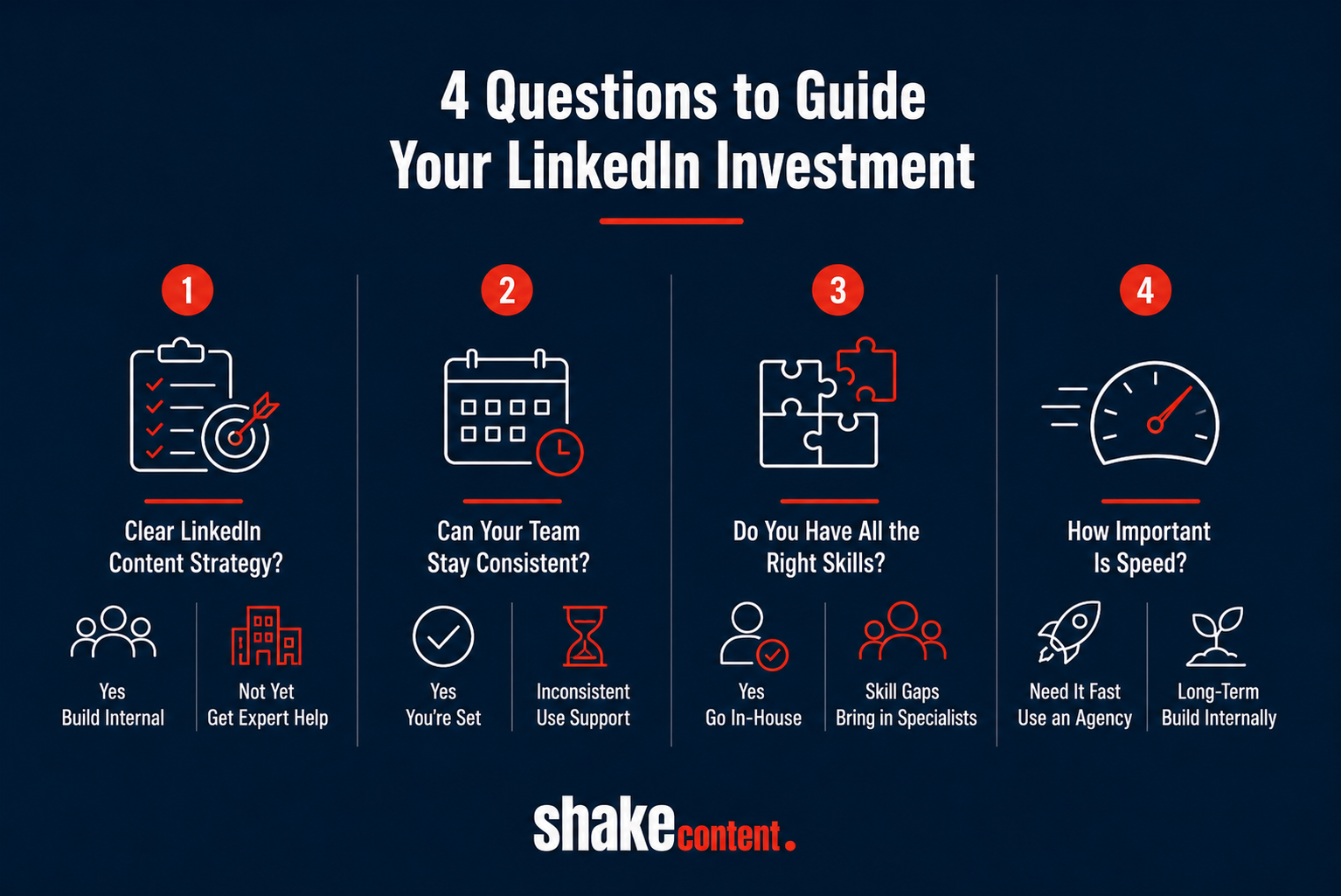
The best choice is usually clearer when you assess your business against four questions.
If your team knows exactly how to build a b2b LinkedIn strategy, they’ll know who it wants to reach, what it wants to be known for, and how content supports wider commercial goals, you may be ready to build internally.
If the strategy is still unclear, an agency can help create the foundation before you invest in headcount.
A strong LinkedIn content strategy should define:
Consistency does not mean posting every day.
It means maintaining a reliable presence that gives your audience repeated exposure to your expertise, perspective, and proof.
If your internal team can protect time for strategy, founder interviews, writing, reviews, and performance analysis, an in-house model can work well.
If LinkedIn activity depends on someone finding spare time at the end of the week, an agency is likely to provide more reliable output.
There isn't a specific posting frequency for B2B growth. The right posting cadence will vary by business, but it should be sustainable enough to maintain over months, not just a few enthusiastic weeks.
Strong LinkedIn content requires a combination of skills:
One person can be strong in several of these areas, but few teams have all of them in-house from the start.
A Video LinkedIn agency or specialist LinkedIn partner can fill the gaps without requiring a full internal recruitment plan. This is particularly useful when your strategy depends on founder-led video, high-quality visual assets, or multiple executive voices.
If you need to establish authority quickly ahead of a funding round, category launch, recruitment push, or new market entry, an agency can provide immediate momentum.
If your priority is long-term internal capability and you have time to build it, an in-house team may be the better investment.
The key is to avoid confusing speed with shortcuts. A good LinkedIn presence is built through a content system, not a burst of posts. The goal is to create a process that continues to produce relevant, credible content long after the initial launch.
The right choice depends on your business. A LinkedIn Marketing agency is often the better option if you need specialist expertise, your founders have limited time, your content lacks consistency, or you want to build authority without hiring a dedicated team. An in-house team is usually the stronger fit if LinkedIn is already delivering results, you have engaged leaders, established creative capabilities, and the resources to support dedicated ownership. Whichever route you choose, success depends on having a clear strategy, defined workflows, and consistent execution.
For many B2B businesses, the best answer is not agency or in-house. It is both. A hybrid model allows your internal team to provide the business context, subject-matter expertise, and access to leadership.
The agency brings strategy, editorial structure, production capacity, and an outside view of what will resonate. This model can work particularly well for companies that already have a marketing team but need specialist support to strengthen their LinkedIn content strategy. For example, an internal marketing lead might own brand direction and approvals, while a LinkedIn Marketing agency manages founder interviews, content planning, writing, design, and performance reviews.
This avoids the common problem of trying to build every capability internally before LinkedIn has proved its value.
The decision between a LinkedIn Marketing agency and an in-house team should not be based on who can publish the most posts. It should be based on who can build the strongest, most sustainable LinkedIn content system for your business.
An agency gives you specialist expertise, speed, and production capacity. An in-house team gives you proximity, context, and long-term ownership. A hybrid model can combine the strengths of both.
The right choice depends on your current capability, your growth priorities, and how seriously you want to treat LinkedIn as a channel for B2B thought leadership.
It depends on the level of support you need. An in-house team can become more cost-effective when you have enough ongoing work to justify several dedicated roles. However, a LinkedIn Marketing agency can provide strategy, writing, design, video, and content operations without the cost and time involved in hiring a full team.
Yes, if the agency has a strong founder insight process. The best Founder Brand agencies do not invent a voice for the founder. They extract existing opinions, experiences, language, and stories, then shape them into clear LinkedIn content.
Often, yes. An agency can complement an in-house team by providing specialist LinkedIn strategy, editorial support, founder content workflows, or extra production capacity. This is especially useful when the internal team has strong business knowledge but limited time or LinkedIn-specific expertise.
LinkedIn thought leadership is a long-term activity. Early signals can include stronger engagement from relevant people, increased profile visits, and more conversations. The larger commercial benefits usually build over time as your audience sees repeated evidence of your expertise and credibility.
The ideal team depends on your goals, but it may include a content strategist, copywriter, designer, video specialist, social media manager, and marketing lead. In smaller businesses, one or two people may cover several of these responsibilities, provided they have enough dedicated time and a clear process.
Yes. A Video LinkedIn agency can help plan, script, edit, and distribute video content that supports founder visibility and B2B storytelling. Video is most effective when it sits inside a wider LinkedIn content strategy rather than being treated as a standalone tactic.
Look beyond likes. Useful measures include engagement from relevant decision-makers, profile visits, inbound conversations, website traffic, self-reported attribution, pipeline influence, conversion rates, and sales-cycle length. The right metrics should connect back to the commercial objective you set at the start.


